Pagani Design Dress Watch: Which One Fits Under a Cuff
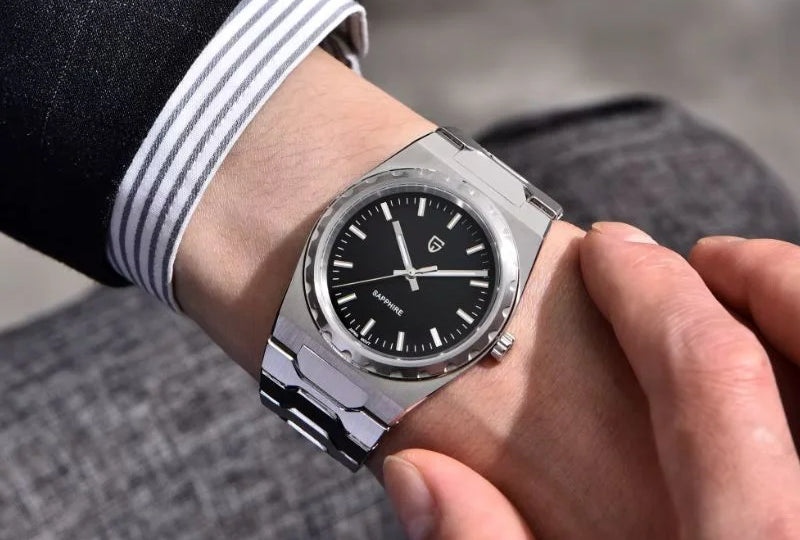
A dress watch has one job: to disappear under a shirt cuff and reappear when you turn your wrist. Everything usually written about dress watches — the clean dial, the slim markers, the absence of a chronograph — follows from that single requirement, and almost none of it is measured in the place people actually look. Buyers compare case diameter. The cuff does not care about diameter.
What decides whether a watch slides under a cuff is its thickness, and thickness is the number most product pages bury. This guide takes the eight watches in this catalogue that can honestly be called dress watches, lays out what each publishes, and is straight about which ones compromise — including the one that is thinnest but not on leather, and the one whose bracelet you can never change.
The Short Answer
Under 10 mm thick is a genuine dress watch; 10 mm to 12 mm still works under most cuffs; above 13 mm it catches. In this catalogue that means the 7 mm Royal Slim first, then the 10 mm Vanguard Classic and Copper Moon on leather. If it must be worn with a suit and go unnoticed, choose by thickness and weight — not by case diameter.
The Measurement That Actually Matters
Hold a shirt cuff between two fingers and you have roughly the clearance a watch has to pass through. A 7 mm case goes under without being noticed. A 10 mm case goes under with a small pause. A 13 mm case has to be pushed, and after a day of that you stop wearing the watch with a shirt.
Diameter matters for how the watch looks, not for how it wears under clothing. A 36 mm case that is 13 mm thick is a small watch that still catches; a 40 mm case at 10 mm slides. That is the reversal most buyers do not expect, and it is visible in the table below: the smallest watch here is one of the thickest.
Weight is the second thing you feel and the last thing anyone checks. The range here runs from 49 g to 143 g — nearly three times — and under a jacket sleeve the heavy one announces itself all day.
Eight Candidates, Measured
These are the eight watches with a plain dial — no chronograph, no GMT bezel, no open dial — that publish both a case size and a thickness, ordered by the number that decides it. Three plain-dial models are missing from the table for reasons worth knowing: the Aureon is 43 mm and 15 mm thick, which rules it out on both counts, and the Prestige Edition and the Aurum Frost do not publish a thickness at all.
| Watch | Case | Thickness | Weight | Worn on |
|---|---|---|---|---|
| Royal Slim | 37 mm | 7 mm | 109 g | Steel bracelet |
| Vanguard Classic | 40 mm | 10 mm | 59 g | Leather |
| Copper Moon | 40 mm | 10 mm | 53.6 g | Leather |
| Midnight | 40 mm | 11 mm | 49 g | Leather |
| Solarius | 35–39 mm | 11.5 mm | — | Steel bracelet |
| Eclipse Classic | 42 mm | 11.7 mm | 143 g | Integrated steel |
| Blue Meridian | 42 mm | 12 mm | 73.7 g | Leather |
| Aurelia | 36 mm | 13 mm | 138 g | Steel bracelet |
Read the first and last rows together and the point makes itself. The Aurelia is the smallest case in the whole catalogue at 36 mm — the classic dress diameter — and at 13 mm it is the thickest watch in this table, because a self-winding mechanical movement needs the height. The Royal Slim is a millimetre larger across and almost half the height.
The Thinnest One Is Not on Leather
Convention says a dress watch belongs on a leather strap. This catalogue does not oblige: the thinnest watch in it, by a clear margin, arrives on a steel bracelet with a butterfly clasp. If you follow the rule you get 10 mm on leather; if you follow the measurement you get 7 mm on steel. Both are defensible, and it is worth knowing you are choosing between them rather than assuming the two go together.
Where leather does win outright is weight. The three leather models here are the three lightest — 59 g, 53.6 g and 49 g — while every steel bracelet in the table is over 100 g. A leather strap also adjusts by buckle hole, so it fits the day it arrives, where a bracelet usually needs links removed first. The leather strap guide compares the full leather range.
What You Can Change Later, and What You Cannot
A dress watch is often the watch someone owns longest, which makes the strap question a long-term one. Standard lug widths — 20 mm and 22 mm — can be re-strapped at any time, in any material. Two models here cannot.
| Watch | Glass | Strap width | Can it be re-strapped? |
|---|---|---|---|
| Vanguard Classic | Sapphire | 20 mm | Yes, standard width |
| Copper Moon | Sapphire | 20 mm | Yes, standard width |
| Midnight | Hard-coated | 20 mm | Yes, standard width |
| Aurelia | Sapphire | 20 mm | Yes, standard width |
| Blue Meridian | Sapphire | 22 mm | Yes, standard width |
| Royal Slim | Sapphire | 26 mm | Bracelet, non-standard width |
| Eclipse Classic | Sapphire | 24.3 mm | No — integrated bracelet |
Two things in that table are worth stating plainly rather than leaving in a cell. The Eclipse Classic has an integrated bracelet: the metal is part of the case design, not attached between two lugs, so there is no version of it on leather — ever. And the Midnight is the one watch here with hard-coated glass rather than sapphire. It is also the lightest watch in the guide at 49 g and among the cleanest dials, so it is a real candidate; the glass is simply the trade it asks you to make, and you should know that before rather than after.
What Rules a Watch Out
Three things disqualify a watch from this job, and none of them is a matter of taste. A chronograph dial puts two or three sub-dials where a dress watch wants empty space — and the chronographs in this range run from 39 mm to 46.5 mm across and 12 mm to 14 mm thick, so most of them fail on both counts at once. A case over 42 mm stops sitting inside a cuff at all. And a busy dial — a date at three, a day at twelve, luminous batons and a tachymeter bezel — reads as a sports watch under a jacket no matter how thin it is.
The moon phase on the Copper Moon is the interesting exception. It is a complication, so in theory it adds clutter; in practice it is a single aperture on an otherwise plain copper dial, and it belongs to the dress tradition rather than the sports one. At 10 mm and 53.6 g it stays inside every rule that matters.
Which One to Choose
If the watch has to go under a shirt cuff daily and never catch, take the 7 mm Royal Slim and accept a steel bracelet and a non-standard width. If you want the traditional look — leather, plain dial, light on the wrist — take the Vanguard Classic at 10 mm or the Midnight at 49 g, and check the glass note above before deciding between them. If you want a mechanical movement in a dress case, the Aurelia is the only 36 mm option, and the 13 mm thickness is the price the movement charges — the automatic versus quartz guide explains why that height is not negotiable.
Common Questions
How thick should a dress watch be?
Under 10 mm is a true dress watch, 10 mm to 12 mm works under most cuffs, and above 13 mm it catches on the shirt. The thinnest case in this catalogue is 7 mm; the thickest watch in this guide is 13 mm.
What size dress watch should a man wear?
Between 36 mm and 40 mm suits almost every wrist, and 42 mm is the practical ceiling for a watch worn with tailoring. But diameter is the second question — thickness is the first.
Can a dress watch have a steel bracelet?
Yes, and here the thinnest watch does. Leather remains lighter and dresses up more easily, but a slim steel bracelet on a 7 mm case is a dress watch by any measurement that counts.
Is a chronograph a dress watch?
No. Sub-dials fill the space a dress dial wants empty, and every chronograph in this range is at least 12 mm thick, with most of them wider than a cuff comfortably allows.
Which is the lightest watch here?
The Midnight at 49 g, on a leather strap. The heaviest in this guide is the Eclipse Classic at 143 g — close to three times as much, and noticeable within an hour under a sleeve.
Can I put a leather strap on any of these?
On five of the seven, yes: they use standard 20 mm or 22 mm widths. The Eclipse Classic has an integrated bracelet and cannot be re-strapped at all, and the Royal Slim uses a 26 mm bracelet rather than a standard strap width.
Short Summary
Choose a dress watch by thickness first: under 10 mm disappears under a cuff, over 13 mm catches. The thinnest here is 7 mm on a steel bracelet; the lightest is 49 g on leather, with hard-coated glass instead of sapphire. The smallest case, at 36 mm, is also the thickest at 13 mm, because its movement is mechanical. One model, the Eclipse Classic, has an integrated bracelet and can never be worn on leather.
Continue reading
- What Makes Luxury Watches Worth Buying? — the wider buying criteria, from movement to water resistance.
- Automatic vs quartz watches — why a mechanical movement adds height, and what it gives back.
- Pagani Design leather strap watches — the full leather range compared by case size, weight and strap width.
- Pagani Design gold watches — gold, rose gold and two-tone compared — and what the gold finish actually is.
- How to choose a watch as a gift — case size, bracelet fit and the mistakes that put a watch in a drawer.
- Classic watches — the clean-dial side of the catalogue, where every watch in this guide sits.