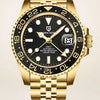
Stainless Steel Bracelet Watches: Will It Fit Your Wrist?

A steel bracelet is the part of a watch that fails you first, and it fails in a way nobody warns you about. It does not arrive fitting your wrist. It arrives at a factory length, and someone has to take links out before it sits properly — a jeweller, or you with the right tool. Until that happens the watch slides, and a sliding watch gets taken off.
Before that, there is a question almost no buyer asks and no product page puts in the headline: how big does the bracelet actually go? In this catalogue the maximum perimeter runs from 172 mm to 240 mm — a 68 mm spread between the smallest and the largest, on watches whose case sizes are only 5 mm apart. This guide puts that number where you can see it, along with the two models whose bracelet can never be changed.
The Short Answer
Measure your wrist with a tape, add about 15 mm, and compare the result with the maximum perimeter in the table below. A 19 cm wrist needs roughly 205 mm and rules out three of the watches here. Bracelets shorten by removing links, but none of them lengthen — so the maximum is the number that decides, and it is not the case size.
The Number That Decides Whether It Fits
Case diameter tells you how a watch looks. Maximum perimeter tells you whether you can close it. They are unrelated: the 42 mm Eclipse Classic closes at 172 mm, while the 42 mm Explorer goes to 240 mm. Same case size, 68 mm apart in what they will fit.
To use the number, wrap a tape measure around your wrist just past the bone and read the circumference. Add 10 mm to 20 mm for the case and the bracelet's own thickness, and you have the perimeter you need. Anything below that will not close on you at all, and links can only make a bracelet smaller.
| Watch | Case | Max perimeter | Bracelet width | Bracelet type |
|---|---|---|---|---|
| Eclipse Classic | 42 mm | 172 mm | 24.3 mm | Integrated |
| Royal Slim | 37 mm | 178 mm | 26 mm | Non-standard width |
| Sterling Chrono | 39 mm | 187 mm | 20 mm | Standard lugs |
| Rose Horizon | 40 mm | 210 mm | 24.5 mm | Integrated |
| Aurelia | 36 mm | 220 mm | 20 mm | Standard lugs |
| Apex | 40 mm | 220 mm | 20 mm | Standard lugs |
| Regal | 40 mm | 220 mm | 20 mm | Standard lugs |
| Urban Motion | 40 mm | 220 mm | 20 mm | Standard lugs |
| Explorer | 42 mm | 240 mm | 20 mm | Standard lugs |
Two rows deserve a warning rather than a cell. The Eclipse Classic tops out at 172 mm — the shortest bracelet in the catalogue, on one of the largest cases. It suits a wrist of about 16 cm or less, so measure before you order it. The Royal Slim closes at 178 mm, which is generous for a 37 mm dress watch but still the second shortest here.
At the other end, the Explorer's 240 mm will fit almost any wrist and will need the most links taken out of any watch here if yours is average. That is the trade the number describes: a long bracelet fits more people and needs more adjustment.
The Adjustment Nobody Mentions
Every steel bracelet in this catalogue arrives at its full length. On an average wrist that means two or three links have to come out before the watch sits where it should, and that is a job with a small tool and a pin — five minutes for a jeweller, and a lost afternoon for anyone doing it for the first time with a kitchen knife.
One model states it outright: the Royal Slim publishes an upgraded bracelet with additional detachable links, which is the same operation described honestly. The rest simply do not raise the subject. It is not a defect — it is how every steel bracelet in the world is sold — but it is the single most common reason a new watch does not get worn in its first week.
If the watch is a gift, this matters more than anything else on the page: a bracelet will not fit the person opening the box, and a leather strap will. The gift guide goes through that decision, and the leather strap guide covers the alternative.
Two Bracelets You Can Never Change
Most of the watches here use standard 20 mm lugs, which means the bracelet is attached between two horns and can be swapped for leather, rubber or a different bracelet at any point in the watch's life. Two cannot.
The Eclipse Classic (24.3 mm) and the Rose Horizon (24.5 mm) both use an integrated bracelet: the metal is drawn as part of the case, flowing out of it rather than pinned to it. There is no gap to fit a strap into, and no version of these watches on leather will ever exist. That is a design decision rather than a fault — integrated bracelets are the reason those two look the way they do — but it is permanent, and worth knowing before rather than after.
The Royal Slim sits in between at 26 mm: a conventional bracelet, but at a width no standard strap is sold in. In practice that makes it a bracelet-only watch too.
What Steel Buys You That Leather Does Not
Water resistance, and the pattern is absolute in this catalogue: every model that declares a water rating is on a steel bracelet. Not one leather model states one.
| Watch | Water resistance | Glass | Clasp |
|---|---|---|---|
| Asterion | 200 m | Sapphire | Folding, with safety |
| Apex | 100 m | Sapphire | Folding safety buckle |
| Gold Summit | 100 m | Sapphire | Folding safety buckle |
| Saturn | 100 m | AR sapphire | Folding, with safety |
| Lunarsteel | 100 m | AR sapphire | Folding, with safety |
| Prestige Edition | 100 m | Not stated | Folding, with safety lock |
| Aurum Frost | 100 m | Not stated | Not stated |
| Solarius | 10 bar | Sapphire | Folding, with safety |
Steel also survives what leather does not — sweat, rain, a sink — and it is the reason a bracelet watch can be worn every day for years while a strap is a consumable. What it costs you is weight: every steel-bracelet watch here that publishes a figure is over 100 g, from the 109 g Royal Slim to the 175 g Explorer, while the lightest leather model in the catalogue is 49 g.
Which One to Choose
Start with your wrist. Below about 16 cm every watch in the first table is available to you, including the two integrated ones. Above roughly 16.5 cm the Eclipse Classic and the Royal Slim come off the list, and above about 17.5 cm the Sterling Chrono goes with them — before style enters the conversation at all.
Then decide whether you want the option to change the bracelet later. If yes, choose one of the 20 mm models — the Sterling Chrono, Apex, Regal, Urban Motion, Aurelia or Explorer — and you keep the freedom to put it on leather in five years. If the look of an integrated bracelet is what drew you in, take it knowing the decision is final. And if water resistance matters, the steel side is where every rating in this catalogue lives, from 100 m up to the Asterion's 200 m — the automatic versus quartz guide covers what else that watch declares.
Common Questions
How do I know if a steel bracelet will fit my wrist?
Measure your wrist circumference with a tape and add 10 mm to 20 mm. Compare that with the maximum perimeter of the watch. Bracelets only shorten, so if your figure is above the maximum, the watch will not close.
Do steel bracelets need to be adjusted?
Almost always. They arrive at full factory length and two or three links usually have to be removed. A jeweller does it in minutes; it is not something that happens on the morning you first wear it.
What is an integrated bracelet?
One drawn as part of the case rather than pinned between two lugs. It cannot be replaced with a strap of any kind. Two watches here have one: the Eclipse Classic and the Rose Horizon.
Can I put a leather strap on a steel bracelet watch?
On the ones with standard 20 mm lugs, yes, at any time. Not on the two integrated models, and not realistically on the Royal Slim, whose 26 mm bracelet is not a width straps are sold in.
Are steel bracelet watches heavier?
Considerably. Every steel model here that publishes a weight is over 100 g and the heaviest is 175 g, against 49 g for the lightest leather watch in the catalogue. You notice it within an hour.
Is 316L stainless steel better?
It is the grade used for watch cases because it resists corrosion and skin reaction well. Two models here state 316L explicitly for both case and bracelet; the others say stainless steel without naming a grade.
Short Summary
Choose a steel bracelet by maximum perimeter, not case size: the range here is 172 mm to 240 mm, and a bracelet only ever gets shorter. Expect to have two or three links removed before it fits. Two models — the Eclipse Classic and the Rose Horizon — have integrated bracelets that can never be swapped for a strap. Steel is where every water rating in this catalogue sits, and it costs you weight: over 100 g in every case.
Continue reading
- What Makes Luxury Watches Worth Buying? — the wider buying criteria, from movement to water resistance.
- Pagani Design leather strap watches — the leather side compared by case size, weight and strap width.
- Pagani Design dress watch — why thickness, not diameter, decides what fits under a cuff.
- Automatic vs quartz watches — the movement behind each of these, and the meca-quartz category between them.
- How to choose a watch as a gift — why a bracelet rarely fits the person opening the box.
- Stainless steel bracelet watches — the full steel range, every rating and clasp in this guide.