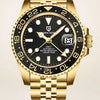
Automatic vs Quartz Watches: Which Should You Buy?

Automatic or quartz is the first real decision in buying a watch, and it is usually presented as a question of taste — mechanical craft on one side, cheap convenience on the other. That framing is wrong, and the specifications of any real collection show why. Automatic watches are thicker and heavier. Quartz watches keep better time. Neither of those is a matter of opinion.
This guide sets the two side by side using the published specifications of every model in this catalogue: eight automatic families and twelve quartz families, with the movement, case size, thickness and weight each one actually declares. It also covers the category that sits between them and rarely gets named, and the models whose spec sheet stays silent about what is inside.
The Short Answer
Choose an automatic if you will wear the same watch most days and you want the movement itself to be part of the appeal. Choose quartz if you rotate between watches, if you want the thinnest or lightest option, or if you want a watch that is still showing the right time after three weeks in a drawer. In this range the thinnest watch is 7 mm and the lightest is 49 g — both of them quartz.
What Actually Separates the Two
An automatic watch is a mechanical watch that winds itself. A rotor spins with the movement of your wrist, tensions a mainspring, and the spring drives the gears. No battery is involved. Take the watch off and it keeps running on the tension already stored — roughly a day and a half on the movements used here — and then it stops.
A quartz watch runs on a battery that vibrates a quartz crystal at a fixed frequency. There is nothing to wind and nothing to store. It runs in a drawer exactly as well as it runs on a wrist, for about two years, and then the battery is replaced.
Everything else follows from that difference. The mechanical watch needs a rotor, a mainspring barrel and a wheel train, which is why it is thicker. The quartz watch needs a circuit, a coil and a cell, which is why it can be made 7 mm thick.
The Three Differences You Feel on the Wrist
1. One of Them Stops When You Take It Off
This is the difference that decides it for most people, and it has nothing to do with quality. An automatic watch worn every day never stops. An automatic watch worn on Saturdays is found stopped every Saturday, and has to be reset before it goes on. If you own several watches and wear them in rotation, every automatic in the rotation will need resetting, every time.
Two of the automatics here are declared as hand-winding as well as self-winding — the Asterion and the Solarius — which means you can wind them by the crown instead of waiting for the rotor. That shortens the ritual; it does not remove it.
2. The Automatic Is the Thicker and Heavier Watch
Not sometimes: consistently, and by a wide margin. Every automatic here that publishes a figure sits between 11.5 mm and 15 mm thick. The quartz models start at 7 mm. The heaviest watch with a published weight is an automatic at 175 g; the lightest is a quartz at 49 g. That is more than three times the weight, and an hour on the wrist is enough to notice it.
This matters more than the specification sheet suggests, because thickness is what decides whether a watch slides under a shirt cuff. If you wear tailoring, the 7 mm quartz case is a genuinely different object from the 15 mm automatic — and no amount of mechanical merit changes that.
3. Accuracy Runs the Other Way
A good mechanical movement is expected to run within roughly ten to thirty seconds a day. A quartz movement is expected to run within about fifteen seconds a month. The quartz watch is not slightly more accurate; it is accurate by a different order of magnitude, and that gap is a physical fact of how the two work, not a difference in price or care.
What the mechanical watch offers instead is that it is a machine you own outright: it needs no battery, it can be serviced rather than replaced, and it is doing visible work while you wear it. That is the honest trade, and it is a real one — it is just not an accuracy argument.
The Eight Automatic Families
Every one of these is a self-winding mechanical watch, and the table shows what each model publishes. Where a cell is empty, the specification is not stated on the product page — which is itself worth knowing before you buy.
| Watch | Movement | Case | Thickness | Weight |
|---|---|---|---|---|
| Aurelia | Seagull ST16 | 36 mm | 13 mm | 138 g |
| Solarius | Not named | 35–39 mm | 11.5 mm | — |
| Rose Horizon | Hiou ST6 | 40 mm | 13.4 mm | 133 g |
| Prestige Edition | Not named | 40 mm | — | — |
| Regal | Pearl DG5833GMT | 40 mm | 14 mm | 148 g |
| Explorer | Pearl DG5833A | 42 mm | 13 mm | 175 g |
| Aureon | Seagull 2813 | 43 mm | 15 mm | — |
| Asterion | Seiko NH35A | — | — | — |
Three things stand out. The Aurelia is the smallest case here at 36 mm, and at 13 mm thick it is still no thinner than the rest — small is not the same as slim. The Solarius does not give a diameter at all but a range, 35 mm to 39 mm, which is a spread of four millimetres and worth resolving before you order. And the Asterion is the only model in the range that declares a 200 m rating, twice anything else here — but it publishes neither a case diameter nor a weight, so you are buying the movement and the rating rather than a known size.
The Twelve Quartz Families
The quartz side is where the range is widest, in every sense: the thinnest case, the lightest watch, the largest case and every chronograph all sit here.
| Watch | Movement | Case | Thickness | Weight |
|---|---|---|---|---|
| Royal Slim | TMI VJ21 | 37 mm | 7 mm | 109 g |
| Sterling Chrono | TMI VK63 | 39 mm | 13.5 mm | 137.8 g |
| Vanguard Classic | Seiko VH65 | 40 mm | 10 mm | 59 g |
| Copper Moon | Epson VX3HA | 40 mm | 10 mm | 53.6 g |
| Midnight | Seiko VH65 | 40 mm | 11 mm | 49 g |
| Apex | Seiko VK63 | 40 mm | 12 mm | — |
| Gold Summit | Seiko VK63 | 40 mm | 14 mm | — |
| Saturn | TMI VK63 | 40 mm | 14 mm | — |
| Lunarsteel | Japan VK63 | 40 mm | — | — |
| Aero Chronograph | TMI VK64 | 44 mm | 12.8 mm | 98.4 g |
| Silver Compass | Not named | 44.5 mm | 12 mm | 72.7 g |
| Royal Chrono | VK67 | 46.5 mm | 14 mm | 75.5 g |
Meca-Quartz: the Category Between the Two
Seven of the twelve quartz families run a movement from the same Japanese family — the VK63, VK64 and VK67 — and these are not ordinary quartz movements. They are hybrids, usually called meca-quartz: the time is kept by a quartz circuit, but the chronograph itself is a mechanical module. Press the pusher and the sub-seconds hand is driven by gears and levers, not by a stepper motor, and when you reset it the hand snaps back to zero in a single instant instead of crawling round the dial.
That behaviour is the reason a meca-quartz chronograph feels like a mechanical one to use, while keeping quartz accuracy and needing no winding. If what draws you to a mechanical watch is the way a chronograph responds under your thumb, this is the category to look at first — and it is the one almost nobody names in a product title. The chronograph guide compares all eight chronograph families by case size, glass and layout.
What the Spec Sheet Does Not Say
Three families in the tables above say only that the movement is automatic, or only that it is quartz, without naming a calibre. That is not a defect and it does not make them worse watches — but if the movement is the specific thing you are buying, buy from the models that name it. Six of the eight automatics name a calibre, and eleven of the twelve quartz models do.
There is a second group worth knowing about: a handful of models in the wider catalogue are in neither collection, because their product pages do not commit to a movement type at all. Among them are the open dial models, whose dial and case back both show mechanical parts. What is visible through the glass is not the same thing as a published calibre, and this guide does not treat it as one — the open heart guide goes through exactly what those two models declare and what they do not.
Which One Should You Buy
Choose an automatic if this will be the watch you wear most days, if you want the movement to be part of what you own, or if you want the 200 m rating that only the Asterion offers. Accept in exchange a case of at least 11.5 mm, a heavier watch, and time drift measured in seconds per day.
Choose quartz if you own more than one watch, if you want a case under 10 mm or a watch under 60 g, or if the watch will be worn occasionally and must be right when it goes on. And choose meca-quartz specifically if you want a chronograph — seven of the eight chronograph families here declare a VK-series movement, and the mechanical reset is the part you will actually use.
Common Questions
Is an automatic watch better than a quartz watch?
Not in terms of timekeeping — quartz is more accurate by a wide margin, typically fifteen seconds a month against ten to thirty seconds a day. An automatic is better if you want a mechanical movement that runs without a battery and can be serviced rather than replaced. They are different objects, not two grades of the same one.
How long does an automatic watch run when you take it off?
Roughly a day and a half on the movements used here, and then it stops and needs resetting. Worn daily, it never stops. That single fact decides the choice for most buyers.
Do automatic watches need a battery?
No. The rotor winds a mainspring from the motion of your wrist, and the spring drives the watch. Two of the automatics here — the Asterion and the Solarius — can also be wound by hand at the crown.
What is a meca-quartz movement?
A hybrid: quartz timekeeping with a mechanical chronograph module. The chronograph hand is driven by gears rather than a motor and returns to zero instantly. Seven of the twelve quartz families here use one — the VK63, VK64 and VK67.
Which is thinner, an automatic or a quartz watch?
Quartz, and not by a small amount. The thinnest quartz case in this range is 7 mm; the thinnest automatic is 11.5 mm and most sit between 13 mm and 15 mm. A mechanical movement needs a rotor and a mainspring barrel, and those take height.
How often does a quartz watch need a new battery?
Around every two years for a standard quartz movement, and sooner for a chronograph that is used regularly, since running the sub-dials draws more current.
Short Summary
An automatic winds itself from your wrist, needs no battery and stops about a day and a half after you take it off; it is the thicker and heavier watch, from 11.5 mm upward here. Quartz runs on a battery for about two years, keeps time far more closely, and includes both the thinnest case in the range at 7 mm and the lightest at 49 g. Seven of the eight chronograph families are meca-quartz hybrids — quartz timekeeping with a mechanical chronograph that resets in one snap.
Continue reading
- What Makes Luxury Watches Worth Buying? — the wider buying criteria, from movement to water resistance.
- Pagani Design chronograph watches — all eight chronograph families compared by case size, glass and calibre.
- Pagani Design open heart watch — the Eclipse Classic open heart and the Artisan skeleton compared.
- Pagani Design leather strap watches — the full leather range compared by case size, weight and strap width.
- How to choose a watch as a gift — case size, bracelet fit and the mistakes that put a watch in a drawer.
- Automatic watches — the eight self-winding families, no battery required.
- Quartz watches — the twelve quartz families, including every chronograph.