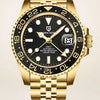
Pagani Design Open Heart Watch: Eclipse Classic or Artisan

Search for a Pagani Design open heart watch and the catalogue answers with two watches that are not the same thing. The Eclipse Classic is a true open heart: a small aperture over the balance wheel on a dial that is otherwise solid. The Artisan Open Dial is a full skeleton, with the dial cut away entirely and the movement serving as the face of the watch.
Which one you want takes about a minute to work out, and the difference runs deeper than the dial. The two also disagree on glass, on what holds them to your wrist, and on weight — and they disagree in ways that pull against each other.
Quick Answer for Buyers
The Eclipse Classic is the open heart: 42 mm, 11.7 mm thick, 143 g, an integrated stainless steel bracelet and synthetic sapphire glass, in blue or grey. The Artisan Open Dial is the skeleton: 43 mm, 13 mm thick, 87 g, a 21 mm leather strap and Hardlex glass, in five colours. The one with the better glass is the one whose bracelet you cannot change; the one you can restrap has the weaker glass.
Open Heart or Skeleton — the Difference in a Paragraph
An open heart dial has a small window, usually near six o’clock, showing the balance wheel and nothing else. The rest of the dial stays solid, so from a metre away the watch reads as an ordinary dress or sports watch with one detail out of place. A skeleton dial removes the dial almost entirely: bridges, wheels and balance are visible across the whole face, and normally through the case back as well.
The Eclipse Classic is the first kind. The Artisan is the second. Listings use the two terms interchangeably and they should not, because they produce completely different watches.
If you wanted a discreet aperture on an otherwise normal watch, the Eclipse is the one. If you wanted to see the mechanism, the Artisan gives you considerably more than an open heart would.
The Two Compared
| Specification | Eclipse Classic | Artisan Open Dial |
|---|---|---|
| Dial | Open heart aperture | Full skeleton |
| Case diameter | 42 mm | 43 mm |
| Case thickness | 11.7 mm | 13 mm |
| Weight | 143 g | 87 g |
| Glass | Synthetic sapphire | Hardlex |
| Wrist band | Steel, integrated | Genuine leather |
| Band width | 24.3 mm | 21 mm |
| Movement reference | Not published | G3265Z |
| Colours | 2 | 5 |
Read down that table and the trade-off is obvious. The Eclipse has the better glass, the thinner case and the more conventional look; the Artisan is 56 g lighter, shows far more of the movement, and lets you change the strap. Neither is a compromise version of the other — they are answers to two different questions.
The Eclipse Classic — the Actual Open Heart
The aperture sits low on the dial with the balance wheel turning behind it, and the rest of the dial is a solid sunburst finish. The case runs straight into the bracelet with no lugs to break the line, which is why it looks wider than 42 mm suggests, and the whole thing is finished as a sport-luxury piece rather than a dress watch.
| Specification | Published value |
|---|---|
| Dial diameter | 42 mm |
| Case thickness | 11.7 mm |
| Weight | 143 g |
| Maximum wrist perimeter | 172 mm |
| Bracelet width | 24.3 mm |
| Bracelet | Stainless steel, integrated |
| Glass | Synthetic sapphire |
| Dial | Open heart, blue or grey |
| In the box | Original gift box |
Two things stand out. The glass is synthetic sapphire, which is the harder material and the right choice on a watch you will wear daily. And it weighs 143 g — steel bracelets do that. That is a watch you feel on the wrist all day, in a way an 87 g leather-strapped watch is not.
The Two Colours
| Colour | Dial | How it reads |
|---|---|---|
| Silver Blue | Deep blue, sunburst | The showier of the two; the aperture stands out against the blue |
| Silver Gray | Warm grey to taupe | Quieter and more formal; the aperture reads as a detail, not a feature |
The Artisan Open Dial — the Full Skeleton
Follow the gear train across the whole dial and the only thing left of a conventional face is a printed chapter ring at the edge carrying the minute markers. The case back is open too, so the movement is visible from both sides.
| Specification | Published value |
|---|---|
| Case diameter | 43 mm |
| Case thickness | 13 mm |
| Weight | 87 g |
| Strap length | 260 mm |
| Strap width | 21 mm |
| Strap | Genuine leather |
| Glass | Hardlex |
| Movement | G3265Z |
| Dial | Open / skeleton |
| In the box | Gift box, multi-language manual, warranty card |
The Five Colours Compared
These are the same watch in five finishes, so the decision is purely about how loud you want it to be.
| Colour | Case | Dial | Strap |
|---|---|---|---|
| Silver Black | Steel | Silver openwork, black chapter ring | Black leather |
| Blue White | Steel | White openwork, blue hands | Blue leather |
| All Black | Black | Dark openwork | Black leather |
| Rose Gold | Rose gold | White and rose openwork | Brown leather |
| Rose Gold Black | Rose gold | Openwork, black chapter ring | Black leather |
The Silver Black is the most neutral and the easiest to wear with anything. The All Black is the quietest despite being the boldest choice — a black case on a black strap reads as one solid object and hides the openwork until you look closely. The Blue White is the only one with a colour accent, and blue hands on a white openwork dial are the most legible combination of the five.
The two rose gold versions are the dressiest. If gold is the reason you are here, the gold range comparison covers the rest of the gold and rose gold models, including which of them are automatic.
How Each One Wears
The Artisan is 43 mm across and 13 mm thick, which means it sits proud of a shirt cuff rather than sliding under it. At 87 g it is not heavy — leather keeps the weight down — but you notice the diameter, and a skeleton dial reads larger than a solid one because there is no block of colour to contain it.
The Eclipse is a millimetre smaller and 1.3 mm thinner, so it goes under a cuff more easily. What you feel instead is the mass: 143 g of steel is over half again the Artisan’s weight. The published maximum wrist perimeter is 172 mm, which is the practical ceiling on a bracelet you cannot swap.
Neither is a small watch. If you normally wear 40 mm or under, both will read as a size up.
Four Things Worth Knowing Before You Buy
1. Only One of the Two Has Sapphire
The Eclipse publishes synthetic sapphire glass; the Artisan publishes Hardlex, a hardened mineral glass. Hardlex is tougher than ordinary mineral, but it marks more easily than sapphire against a door frame or a desk edge. On a watch whose entire appeal is the view through the glass, that is a real difference over a few years — and it happens to fall on the skeleton, the one with the most to show.
2. Neither Is Stated Outright as a Self-Winding Automatic
Both dials are printed AUTOMATIC, and the store describes both as giving an automatic-style experience. The Artisan lists a G3265Z movement; the Eclipse publishes no calibre reference at all. That is the published wording in both cases, and it stops short of stating a self-winding movement. If a genuine automatic matters to you, the Rose Horizon (Hiou ST6) and the Aurelia (Seagull ST16) are both listed explicitly as automatic.
3. One Strap You Can Change, One You Cannot
The Artisan takes a 21 mm strap. Twenty-one millimetres is an uncommon aftermarket size — 20 and 22 are everywhere, 21 is not — so your choice is narrower when the leather wears out, but the option exists. The Eclipse has a 24.3 mm integrated bracelet, which is not a standard strap fitting at all. Treat that bracelet as permanent.
4. Sizing Is Fixed on One and Not the Other
Leather adjusts by the buckle across a wide range. A steel bracelet is sized by removing links, and the Eclipse publishes a 172 mm maximum perimeter, so a wrist above that is out. Measure before you order.
The leather strap comparison lists the strap width of every leather model in the range, including which ones take the common sizes.
Which One Should You Buy?
Buy the Eclipse Classic if you want a watch that passes as normal at a glance, with one mechanical detail for the people who look twice — and if sapphire glass on a daily wearer matters to you.
Buy the Artisan Open Dial if the mechanism is the point, if you want it light on the wrist, if you want the option of changing the strap, and if you can live with Hardlex.
If the finish is what brought you here rather than the dial, the gold and rose gold comparison is the better starting point.
Common Questions
Which Pagani Design watch has an open heart dial?
The Eclipse Classic. It has a small aperture over the balance wheel on an otherwise solid dial, in blue or grey, with synthetic sapphire glass and a stainless steel bracelet. The Artisan Open Dial goes further and opens the whole dial.
Is the Artisan an open heart watch?
Not strictly. An open heart shows the balance wheel through a small window; the Artisan has a fully open skeleton dial that shows the whole movement, front and back. It is what many people mean when they search for an open heart, and it shows more — but it is a different kind of watch.
Which one has sapphire glass?
The Eclipse Classic, with synthetic sapphire. The Artisan publishes Hardlex, a hardened mineral glass that resists scratches better than ordinary mineral but not as well as sapphire.
Are they automatic?
The published wording describes an automatic-style experience for both. The Artisan lists a G3265Z movement; the Eclipse lists no calibre. If a stated self-winding movement is essential, the Rose Horizon and the Aurelia are listed as automatic outright.
Which is better for a smaller wrist?
Neither is small. The Eclipse is 1 mm narrower and 1.3 mm thinner, but 143 g of steel with a 172 mm maximum perimeter; the Artisan is lighter and adjusts freely on leather, but the skeleton dial makes 43 mm read larger still.
Can I change the strap?
On the Artisan, yes — 21 mm, an uncommon but findable width. On the Eclipse, no in practice: the bracelet is integrated at 24.3 mm and does not take a standard strap.
Short Summary
Pagani Design has one true open heart, the Eclipse Classic, and one full skeleton, the Artisan Open Dial. The Eclipse is 42 mm, sapphire glass, an integrated steel bracelet and 143 g; the Artisan is 43 mm, Hardlex, leather and 87 g in five colours. Sapphire and a fixed bracelet on one side; a changeable strap and weaker glass on the other.
Continue reading
- What Makes Luxury Watches Worth Buying? — the wider buying criteria, from movement to water resistance.
- Pagani Design leather strap watches — every leather model compared, including strap widths.
- Pagani Design gold watches — the gold and rose gold range, and which are automatic.
- Pagani Design chronograph watches — all eight chronograph families compared by case size, glass and calibre.
- Automatic vs quartz watches — eight automatic families and twelve quartz compared by movement, case size and weight.
- Pagani Design dress watch — thickness, not diameter, decides what fits under a cuff: eight models from 7 mm to 13 mm.
- Automatic watches — the full automatic range, every one with a declared self-winding movement.
- All leather strap watches — the full 25-watch collection.